

The Human Rights Act 1998 (HRA) is a unique piece of constitutional law because of the way it interacts with other legislation. It can be used to evaluate whether other legislation is compatible with human rights law. In the first place, courts will try to interpret the legislation so that it is consistent with the human rights guarantees provided by the European Convention on Human Rights. If the court is unable to do that, another option is available. The courts may issue a “declaration of incompatibility”, which lets the legislature know that a piece of legislation is capable of operating incompatibly with human rights law in certain circumstances and that they couldn’t interpret the law in such a way as to get rid of the problem. In this blogpost I will look at some statistics I have gathered on declarations of incompatibility, in particular how the government responds to them and what it tells us about the role of parliament in responding to human rights violations.
The power to issue a declaration of incompatibility has been used sparingly by the courts over the years. It is considered a last resort, and the courts have only issued 52 declarations of incompatibility in the 24 years since the implementation of the Human Rights Act (and 12 of those were later overturned by higher courts on appeal). In practice, the executive and legislature have typically responded positively to declarations of incompatibility by changing the legislation in response to the court’s judgment. This has become so common that some academics have speculated over whether changing the law in response to the declaration of incompatibility has become a constitutional convention in the UK. While this is unremarkable, the ways in which the executive and parliament have responded to declarations of incompatibility over time have changed markedly, giving rise to some interesting issues.
In the early days of the HRA from 2000-2010, the government had to deal with 27 declarations of incompatibility. 8 were overturned on appeal and one, Smith v Scott, was addressed by a variety of different measures. Of the other 18, 15 were addressed using primary legislation, an Act of Parliament, while the government used “remedial orders” to address the other three. A remedial order (a kind of Henry VIII power) enables subordinate legislation to amend or repeal primary legislation in response to a declaration of incompatibility or a judgment from the European Court of Human Rights.
More recently from 2010 to today there has been a marked change in practice in how the executive responds to declarations of incompatibility, with the executive now using subordinate legislation much more often. The government has had to deal with 25 declarations of incompatibility since 2010. The resolution of 6 are still pending at the time of writing and 4 were overturned on appeal, leaving 15 “resolved” declarations of incompatibility. Of these, the government used subordinate legislation to address 12 and primary legislation to address 3. This is almost a complete inversion of the position in the first 10 years of the HRA. So why has this happened and is it a problem?

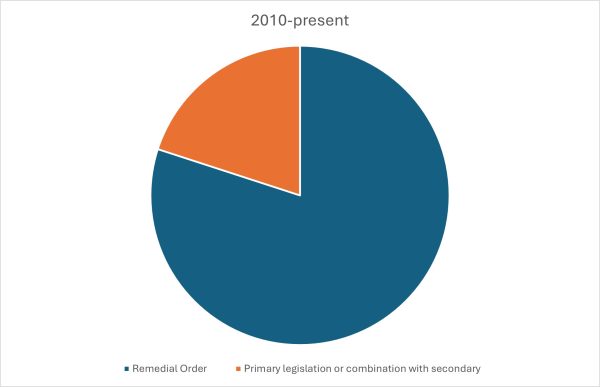
Looking at the first question: Why has this happened? The exact reason is unclear, but it coincides with a number of different factors. First, it coincides with the Conservative party taking office. Secondly, the Joint Committee on Human Rights (JCHR) encouraged the government to make greater use of remedial orders to “provide a speedy response to adverse human rights judgments” in 2010. The JCHR, quite reasonably, thought that using secondary legislation rather than waiting for appropriate primary legislation to address the declaration of incompatibility would speed things up. Thirdly, the increased use of remedial orders is part of a more widespread trend of governments using Henry VIII powers, which has been identified by several scholars including Jack Beatson and Alison Young.
Looking at the second question – is it a problem? I think it is. At a general level, Henry VIII powers are problematic for several reasons. By allowing subordinate legislation to amend hierarchically superior legislation, they violate basic rules of hierarchy in the legal system. They also pose problems from the standpoint of the separation of powers by enabling the executive to perform functions of the legislature. Some academics, like Eric Barendt, argue that the failure to separate functions of government among the different arms of government is only problematic when it compromises the ultimate aim of the separation of powers i.e. to avoid abuse of power. It is nonetheless worth recognising the potential for parliament to be marginalised by the executive in this process, especially in a constitutional system like the UK’s where the legislature and executive are fused.
There are also problems germane to remedial orders. Firstly, the HRA shows a preference for the government to use primary legislation to address declarations of incompatibility rather than remedial orders because there have to be “compelling reasons” to use a remedial order. In practice there has been little scrutiny of whether “compelling reasons” have been provided to justify the use of remedial orders. The most frequently cited reason for using a remedial order, rather than primary legislation, is that it can remedy the incompatibility more quickly. Yet despite using this compelling reason and it serving as the motivation for the JCHR to encourage more frequent use of remedial orders, the governments of the past 14 years have been far from swift in responding to declarations of incompatibility. The first remedial order used, the Mental Health Act 1983 (Remedial) Order 2001, took a mere 243 days between the court issuing the declaration of incompatibility and the remedial order entering into force. But as time has gone on, the government is taking longer and longer to implement remedial orders. At the outer limits, the State Immunity Act 1978 (Remedial) Order 2023, which was adopted in response to the Benkharbouche litigation took 1954 days between final judgment and the entry into force of the remedial order. The average time between final judgment and the entry into force of remedial orders is now over 3 years. When remedial orders are already taking several sessions to pass, it is difficult to see why primary legislation could not be planned and implemented in that timescale or to justify their use on the grounds that they are addressing declarations of incompatibility more quickly.

Secondly, while remedial orders are subject to an enhanced form of scrutiny when compared with other forms of subordinate legislation, so-called “super affirmative procedure”, it is not equivalent to the scrutiny provided for primary legislation. As the JCHR observes, using primary legislation is likely to “maximize the opportunities for Members of each House to scrutinize the proposed amendments in detail”. Crucially, primary legislation allows for amendments to Bills to be proposed. The remedial orders process “does not allow for Parliament directly to amend either a draft remedial order or a remedial order—only to suggest amendments”. As a result, the role of parliament in the process of remedying violations is severely diminished, with the executive taking the lead. There are some signs this may be intentional. One of the justifications for introducing the Human Fertilisation and Embryology Act 2008 (Remedial) Order 2018 was the department’s view that a short piece of primary legislation might “give the opportunity to re-open other provisions in the 2008 Act through amendments, which could undermine the intentions of the Bill and lead to debate on different issues long settled by the UK Parliament”. The implication being that parliament could not be trusted to stay on task if primary legislation were utilised. The apparent marginalisation of parliament in this way is troubling. When the Human Rights Act was conceived, parliament was meant to “play a leading role in protecting the rights which are at the heart of parliamentary democracy”. Yet as time has gone on academics, like Alison Young and Janet Hiebert, have questioned whether parliament has fully embraced the role envisaged for it under the Act. This may be evidence of the parliament being frozen out of the conversation on rights protection – with the judiciary involved at one end, issuing the declaration of incompatibility, and the executive at the other, implementing the remedial order with limited input from parliament in between.
The objective behind remedial orders is noble and they certainly have a role to play in remedying human rights violations and addressing incompatible legislation. But at present they are not delivering their unique selling point – speed. Instead, we have ended up with the worst of both worlds, lacking the detailed scrutiny of how the government is responding to a particular declaration of incompatibility offered by passing primary legislation and lacking the speed offered by the remedial order. The new government should, in principle at least, be less hostile than the Conservative Party was to the HRA. There is an opportunity for the government to reset their approach to the HRA and change how they respond to declarations of incompatibility, shifting back to using primary legislation in keeping with the intentions of the Act. While there is clearly pressure on parliamentary time, addressing declarations of incompatibility and giving space for parliament to assess different options is important, indeed central to the role they are supposed to have under the Human Rights Act. Primary legislation need not take a long time to pass either, as the JCHR notes, a short Bill could be drafted quickly and passed swiftly through both Houses to remedy an incompatibility. If the government decides to continue with the current practice of using remedial orders, they must speed up the process through which remedial orders are brought forward and implemented. If they don’t speed up the remedial process, human rights violations will continue for longer, negatively impacting victims and creating further problems for the government. It is in everyone’s interest that declarations of incompatibility are dealt with swiftly and that parliament can play its proper role in this process.
Stuart Wallace.
Stuart Wallace is an Associate Professor at the University of Leeds where he teaches constitutional law and international human rights law. He is a contributing writer for the Constitution Society.
The Constitution Society is committed to the promotion of informed debate and is politically impartial. Any views expressed in this article are the personal views of the author and not those of The Constitution Society.